Don’t Let Your Holidays Get Routed: Stopping Gout Before It Starts

With the arrival of late fall across Fort Mill and York County, you may notice a shift in your routine. Friends and family are arriving, holiday meals are being prepped while standing on hard tile floors, and the whole occasion can pass by in a flash.
Whether you’re traveling to see family or indulging in seasonal get-togethers at home, our lower extremities face a unique combination of mechanical and metabolic stressors. Because this time of year is so busy, it’s easy to ignore foot and ankle problems until they catch you off-guard with pain, weakness, or other concerning symptoms.
At SmartStep Foot and Ankle, the days immediately following Thanksgiving consistently bring a sharp clinical spike in acute lower-extremity pain for many people. Patients often arrive at our office limping, unsure whether their throbbing foot is the result of standing on hard floors all day or whether it’s something systemic.
Before you break out the turkey baster this year, it’s important to understand how traditional holiday foods and traditions interact with physical joint stress as these elements are often the key to stopping acute foot pain before it ruins the occasion.

Metabolic Spiking: Why Thanksgiving Feasts Trigger Acute Gout
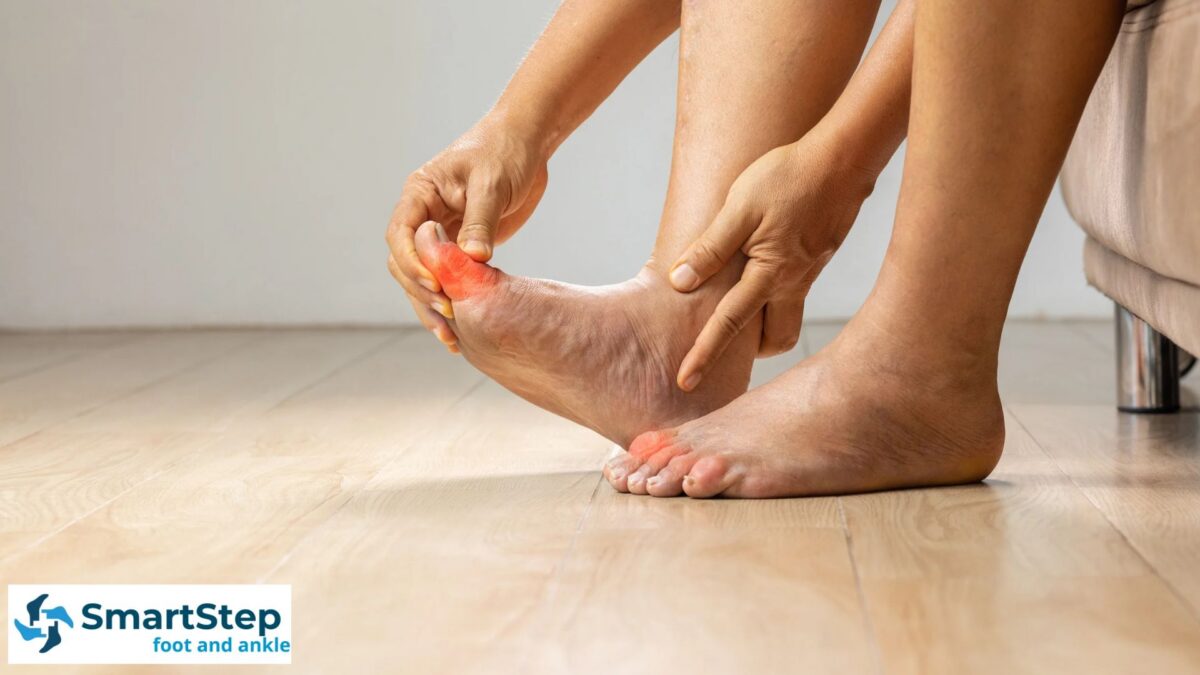
Gout is a painful form of inflammatory arthritis caused by the crystallization of uric acid within a joint. This can occur in a number of places, but most commonly, gout attacks happen in the first metatarsophalangeal joint of the big toe.
While many know that purine-rich foods contribute to uric acid production, the holiday table overall often creates a compounding metabolic cascade:
- Gravy and Dark Meat: Rich turkey skin, dark meat, organ-meat giblet gravies, and cured holiday hams are densely packed with purines. When consumed in large portions, the body’s ability to clear circulating uric acid through the kidneys is temporarily overwhelmed.
- Fructose and Alcohol: Sweets like holiday pies, cranberry sauces sweetened with high-fructose corn syrup, and festive wine or craft beer present a dual challenge. Fructose accelerates uric acid synthesis while alcohol metabolism produces lactic acid. This process directly competes with uric acid for renal excretion. The kidneys prioritize clearing the alcohol byproducts, leading to serum uric acid levels rising.
- Dehydration and Nighttime Temperatures: After a heavy meal paired with alcohol and high sodium, fluid shifts out of vascular spaces. As core body temperature drops during sleep and peripheral circulation to the toes cools down, hyper-saturated uric acid falls out of solution. What ends up happening is that microscopic, needle-like monosodium urate crystals find themselves directly inside the joint capsule.
Kitchen Fatigue and Capsulitis
Not all post-Thanksgiving forefoot pain is metabolic. Extended hours standing stationary or moving in confined areas while prepping dishes and cooking can bring on severe mechanical joint strain.
Static Forefoot Overload
Walking pumps blood and keeps circulation in a normal rhythm to the lower extremities. Standing in one spot on hard kitchen tile shifts your center of mass forward onto the metatarsal heads or ball of your foot.
Second MTP Joint Capsulitis
Extended periods of pressure inflames the joint capsule and plantar plate beneath the smaller toe joints. This often results in a throbbing, burning sensation, kind of like what stepping on a marble might feel like. In many cases, it can easily be confused with localized systemic joint inflammation.
Distinguishing Gout from Mechanical Joint Strain
Because treating a gout flare-up requires a completely different medical protocol than treating mechanical injuries, an accurate clinical diagnosis is critical. Below are some symptoms that can help your podiatrist differentiate between the two:
Classic Gouty Arthritis
Rapid onset gout, extreme hypersensitivity, deep redness, localized heat, and significant swelling centered at the big toe joint.
Mechanical Capsulitis
Sensation of fullness or a “pebble” under the ball of the foot that builds with weight-bearing, minimal resting redness, and localized tenderness directly beneath the second or third toe rather than the base of the big toe.
In-Office Diagnostics and Rapid Relief at Our Fort Mill Clinic
Attempting to walk off a gout flare-up or pushing through acute forefoot capsulitis risks joint cartilage erosion and long-term ligament damage. When these conditions worsen, treatment becomes more complex.
At our Fort Mill practice, Dr. Lanier provides targeted, rapid-acting clinical care:
- Differential Diagnostic Evaluation: Using on-site digital imaging and hands-on clinical assessments to distinguish crystal-induced arthropathy from structural joint sprains or stress fractures.
- Targeted Anti-Inflammatory Protocols: Initiating fast-acting prescription regimens or localized therapeutic interventions to rapidly break down acute inflammation and restore comfort.
- Mechanical Offloading: Custom orthotic modifications can remove weight-bearing force from irritated joints while they heal.
You don’t have to spend your holidays immobilized with intense foot pain. SmartStep Foot and Ankle provides comprehensive podiatric care directly in our Fort Mill, SC office.
With seamless online booking and same-day and next-day appointments available, we help you get back on your feet quickly.